
Has Your Financial Life Outgrown Your Financial System?
As wealth becomes more complex, coordination matters as much as the individual strategies.
Financial complexity rarely arrives all at once. It builds gradually: another account, a new business interest, a different insurance policy, an estate document completed years ago, or a new professional added to solve one specific problem.
Each decision may have been reasonable when it was made. The risk appears when those decisions accumulate without a system that shows how they connect, who is responsible, and what still requires attention.
Growth Creates More Connections to Manage
A growing financial life creates more than additional assets. It creates dependencies. An investment decision can affect liquidity. A business change can alter insurance needs. An estate-planning decision may require account titles and beneficiary designations to be updated. A tax recommendation may depend on action from an advisor, attorney, accountant, or the client.
When those connections are not visible, good advice can still produce incomplete execution. One professional may assume another is handling the next step. A document may be signed but never reflected in the accounts. A strategy may remain appropriate in isolation while becoming misaligned with the rest of the plan.
The Warning Signs Are Usually Ordinary
A financial system rarely fails in a dramatic moment. More often, small gaps begin to accumulate. Statements arrive from accounts no one discusses. Beneficiary designations have not been reviewed since a major life event. Cash builds without a defined purpose. Insurance coverage reflects an earlier stage of life. Important recommendations live in separate emails, meeting notes, and professional relationships.
None of these issues alone proves the plan is broken. Together, they suggest the financial system may no longer match the complexity it is expected to manage.
A Complexity Audit Creates a Current View
September is a useful time to take inventory before year-end deadlines begin to compress the calendar. A complexity audit does not require rebuilding the entire plan. It begins by creating one current view of the financial life and identifying where coordination is weak.
Start with four questions:
- What exists? List the accounts, entities, policies, estate documents, debts, business interests, and major planning strategies.
- What changed? Identify life, family, business, income, or ownership changes that may have made earlier decisions outdated.
- What is connected? Determine which decisions depend on another account, document, strategy, or professional.
- What remains open? Assign an owner and a completion date to every unresolved action.
This review creates clarity about what deserves attention. It also reveals whether the professionals involved are working from the same priorities and whether recommendations are moving from conversation to completion.
The System Should Make Progress Visible
A coordinated financial system should answer three practical questions at any time: What has been decided? What is being implemented? What needs to happen next?
That visibility matters because complexity consumes attention. When responsibilities, timing, and dependencies are clear, clients spend less energy tracking loose ends and more time making the decisions that genuinely require their judgment.

What to Do This Month
Choose one area of your financial life that has grown or changed in the past year. Confirm that the related accounts, documents, strategies, and professionals still reflect the same priorities. Then identify one open action, assign responsibility, and establish a date for follow-up.
A financial plan should evolve as your life does. The goal is a system capable of keeping every important decision connected and moving forward.
IMPORTANT INFORMATION
For informational purposes only; not individualized investment, tax, or legal advice. Consult the appropriate professional regarding your circumstances.
A major financial event can change your balance sheet overnight. What matters next is how the decisions around it are coordinated.
A professional athlete can receive a substantial signing bonus before career income becomes predictable. The amount may be significant. The career may still be uncertain.
That tension is at the center of Antonio Gonzalez’s recent conversation on the Side Retired Podcast. Antonio discusses the financial realities around professional baseball, but the underlying lesson reaches well beyond sports: receiving a large amount of money does not automatically create a long-term financial plan.
A large check can create a false sense of permanence
A signing bonus can be dramatically different from the income that follows. A young player may be managing more money than he has ever seen while still pursuing a career with uncertain timing and uncertain future earnings.
The same problem appears in other financial situations. A business sale, inheritance, equity payout, large bonus, or retirement distribution can change a balance sheet immediately. It does not necessarily create the recurring income required to support a permanently different lifestyle.
The first question, therefore, should be broader than “How should I invest this money?” A better starting point is: What does this money need to accomplish?
Complexity begins after the money arrives
A major financial event often creates more decisions, not fewer. Taxes may need to be addressed. Cash reserves may need to be established. Investment decisions arise. Family needs, insurance, estate planning, debt, spending, and future income begin to interact.
Different professionals may also become involved. Without coordination, decisions can be made in isolation or remain unfinished even when each individual recommendation appears reasonable.
Clarity, Structure, and Execution
Antonio’s discussion with Side Retired provides a practical example of the Great Wealth process:

Execution matters because a recommendation has limited value when responsibility and timing remain unclear. The work may include coordinating professionals, completing documents, updating accounts, implementing tax or estate-planning steps, assigning responsibility, and following up until the next action is complete.

Listen to the conversation
Antonio explores these ideas through the financial realities professional baseball players face; from signing bonuses and uneven income to family responsibilities and planning around an uncertain career. The examples are specific to sports. The decision-making principles are not.
Listen to “The Financial Perspective: Antonio Gonzalez” on the Side Retired Podcast
Before making a major financial decision, identify what changed, what decisions now require attention, which professionals need to be involved, and who is responsible for making sure the next steps actually happen.
How clarity, structure, and execution move financial decisions forward

Financial progress depends on a series of connected decisions. A tax choice affects cash flow. A business decision changes retirement and estate planning. An investment move can alter both risk and liquidity.
As those decisions accumulate, attention becomes the constraint. Clients may have the information they need and still struggle to determine what matters first, who should be involved, and what must happen next.
Decision Fatigue Slows Progress
Decision fatigue shows up as delay. A beneficiary update stays on the list. Excess cash remains unallocated. An investment change waits for tax guidance. A business owner postpones a planning conversation because several advisors need to coordinate.
Open issues linger when they lack a clear priority, sequence, or owner. Deadlines then drive the process, leaving less time to evaluate options and coordinate recommendations.
Over time, small delays create friction. Strategies drift apart. Professionals address separate pieces without a shared view of the client’s financial life.
Clarity, Structure, and Execution
Great Wealth’s framework creates a direct path from a financial question to a completed action:

Each stage closes an open loop. Clarity narrows the issue. Structure aligns the moving parts. Execution converts the decision into progress.
Execution Creates Confidence
Execution gives the plan credibility. A recommendation becomes useful when it is translated into a task, an owner, and a deadline.
Visible progress builds confidence. Clients can see what has been decided, what is underway, and what will be reviewed next.
Regular follow-up creates accountability. It surfaces delays early and gives each professional a clear view of what has been completed, what remains open, and where the plan needs to adjust.
Use the Next Five Months Intentionally
August provides enough runway to complete meaningful work before year-end. Start by identifying the three financial decisions that matter most between now and December 31.
For each decision, define:
- the desired outcome;
- the information still needed;
- the people who should be involved;
- the next action; and
- the completion date.
Then review the sequence. Make dependencies explicit, schedule the conversations that require multiple professionals, and assign an owner to every next step.

The next five months provide a practical window to reduce decision fatigue and close important gaps. Better decisions do not guarantee a specific result, but they improve the quality, timing, and coordination of the actions that shape financial outcomes.
Many investors are asking the same question:
Where are interest rates headed next?
A more useful question may be:
Has your financial strategy adapted to where interest rates are today?
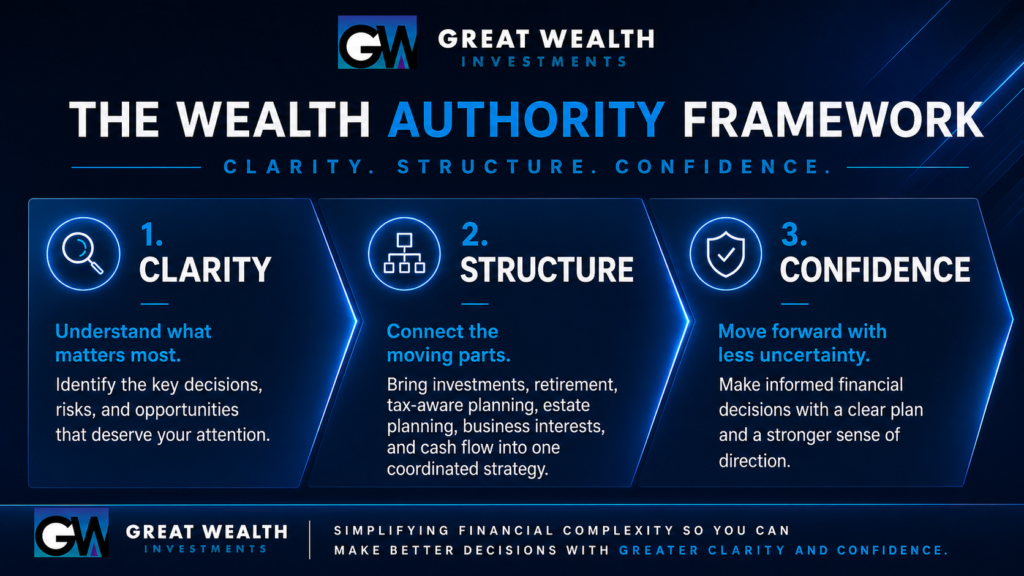
For years, investors operated in a low-rate environment. Borrowing was inexpensive. Cash earned very little. Many financial decisions were built around assumptions that remained largely unchanged for more than a decade.
Today’s environment looks different.
The challenge is not predicting where rates will go next. The challenge is understanding how today’s environment may affect the decisions that matter most.
Clarity
Understanding What Has Changed
When most people hear “higher interest rates,” they think about loans and mortgages.
But today’s rate environment can also affect:
- Cash reserves and emergency funds
- Retirement income strategies
- Fixed-income investments
- Real estate decisions
- Business financing
- Long-term investment allocation
The first step is determining which of these areas deserve your attention and which assumptions may need to be revisited.
Structure
Connecting the Moving Pieces
Financial decisions rarely exist in isolation.
A change in one area often creates consequences somewhere else.
For example:
- A cash decision may affect investment opportunities.
- An investment decision may create tax consequences.
- Tax planning may influence retirement income.
- Business financing decisions may affect long-term wealth accumulation.
The goal is not simply making good individual decisions.
The goal is ensuring those decisions work together within a coordinated strategy.
Confidence
Focusing on What Matters Most
- Economic conditions will continue to change.
- Interest rates will eventually rise, fall, and change again.
- Confidence does not come from predicting the future.
- Confidence comes from knowing that your financial strategy is designed to adapt as conditions evolve.
When your plan is aligned with your goals, short-term headlines become less important than long-term decision making.
THE WEALTH AUTHORITY INSIGHT
“The most important question is not whether interest rates are high or low.”The more important question is whether your financial strategy reflects the environment we are actually living in today.
Sometimes the greatest opportunity is not finding a new investment.
It is making sure the decisions you are already making remain aligned with your goals, your priorities, and your long-term objectives.
Ready for a Second Perspective?
The most valuable financial decisions are rarely made in isolation.
If it has been some time since your plan was reviewed, now may be an appropriate opportunity to evaluate whether your investments, retirement strategy, tax planning, business interests, and liquidity management are still working together toward your goals.